
THEOPOETECOLOGY
Theopoetecology is an emerging interdisciplinary framework developed by Dennis Matthews Jr. at the convergence of theopoetics, ecotheology, and the environmental humanities. Its foundational thesis is that theological perception, the human act of recognizing and being formed by divine meaning, emerges through symbolic ecosystems rather than through singular or propositional interpretive acts. Divine meaning flows through dynamic networks of scriptural imagery, ecological symbolism, cultural narrative, poetic expression, and lived human experience whose interaction generates theological insight that no single symbolic environment could produce alone.
The framework makes three original contributions to the interdisciplinary conversation between theology, ecology, and the arts. The Symbolic Ecosystem Model provides the primary theoretical architecture, proposing a layered account of how divine meaning moves from revelation through multiple symbolic environments toward practical formation in persons and communities. Theopoetecological Narrative Form offers an alternative to conflict-driven narrative models, organizing story structure around five ecological stages of maturation, Seed, Root, Growth, Fruit, and Harvest, and demonstrating this structure through applied reading of biblical parables and contemporary literary texts. The Analytical Coding Protocol provides an eight-domain methodological framework for applying Theopoetecological Reading consistently across texts, artworks, liturgical materials, and landscapes, generating analytical yield unavailable from adjacent fields, including theopoetics, ecotheology, and ecocriticism studied independently.
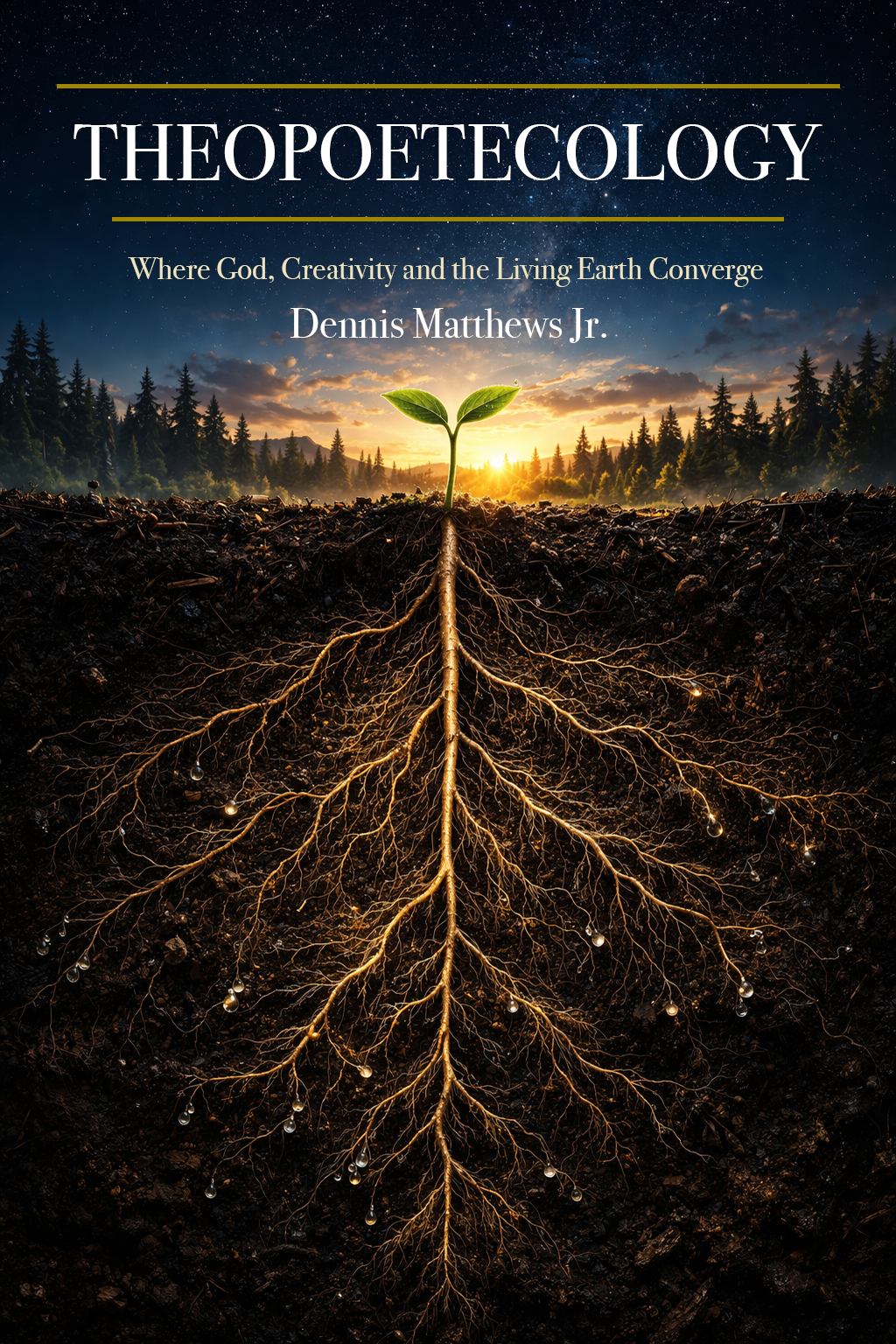
The framework is introduced in full in the book Theopoetecology: Where God, Creativity, and the Living Earth Converge, available now through Amazon. A foundational peer-reviewed article introducing the framework is currently under review at Literature and Theology, Oxford University Press. A complete twelve-episode video course is available through the YouTube series linked below.
📖 Get the Book: https://a.co/d/0iHgoGKq
▶️ Watch the Series: https://youtu.be/zMpii5i4c0s
FAQs
What exactly is Theopoetecology and how do you pronounce it?
1
Theopoetecology is pronounced theo-po-et-e-col-o-gy. It is a constructed word built from three Greek roots: Theos, meaning God; Poiesis, meaning making or creative act; and Oikos, meaning household or dwelling, the root that also gives us ecology, economy, and ecumenism. Put together, the word names the place where theological reflection, creative making, and ecological awareness converge into a single integrated way of seeing and engaging the world.
In practical terms, Theopoetecology is a framework for understanding how divine meaning actually forms in human beings and communities. The central claim is that theological understanding does not primarily arise from correct propositions or doctrinal statements. It flows, the way rain flows through soil, through a living ecosystem of scripture, ecological imagery, poetic language, cultural narrative, and lived experience. When those environments interact, they produce meaning that none of them could generate alone. Theopoetecology is the name for that process, and a set of tools for studying and cultivating it.
How is Theopoetecology different from ecotheology or theopoetics? Isn't this already being studied?
2
Ecotheology and theopoetics are both direct ancestors of this framework, and Theopoetecology would not exist without them. But each field has a gap that the others do not fill.
Theopoetics, the tradition centered at Arts, Religion, and Culture, has established rigorously that imagination, aesthetic form, and embodiment are constitutive of theological knowledge, not supplementary to it. But it has not systematically developed the ecological dimension as architecturally central. When nature appears in theopoetics scholarship, it tends to appear as a theme or image rather than as a living symbolic environment that actively participates in meaning-making.
Ecotheology has made ecological concern structurally central and has produced the most urgent and sophisticated frameworks for understanding the relationship between religious traditions and the natural world. But it has been less consistently attentive to how the poetic, aesthetic, and creative forms through which communities worship and tell their stories actually shape the ecological consciousness it is calling for.
Theopoetecology studies the interaction between these symbolic environments as its primary object. No existing field makes that interactional dynamic its systematic focus. That is the genuine novelty, not a new label for existing work, but a new way of attending to what happens when the theological, the poetic, and the ecological arrive together.
This sounds very academic. What does it have to do with my life, my church, or my community?
3
This is exactly the right question to ask, and it deserves a direct answer.
If you are a pastor, Theopoetecology offers a new structure for preaching, the Theopoetecological Narrative Form, organized around five ecological stages of formation rather than three doctrinal points or a dramatic arc. It gives you a framework for understanding why some sermons form people and others merely inform them, and why the difference is not primarily about delivery or content but about the kind of movement the message makes.
If you are a spiritual director or formation leader, the concept of Ripening gives you a framework for accompanying people through the seasons of their formation without rushing them. It names with dignity the seasons when nothing visible is happening and everything necessary is forming beneath the surface.
If you are a worship designer or liturgist, the Symbolic Ecosystem Model shows how liturgy is already a symbolic ecosystem, and invites you to design it with intentionality, braiding scriptural language, ecological imagery, and communal narrative in ways that produce formation rather than merely performance.
If you are none of those things but you have stood at the edge of a field or beside a body of water and felt something theological that you did not have language for, this framework is for you. It exists to give language to what you have already been experiencing.
Where do I start if I want to engage with this framework?
4
Start wherever your existing questions are most alive.
If you are a visual and auditory learner, start with the YouTube series. Episode 1 introduces the framework from the ground up in about twenty minutes. You can watch the full twelve-episode course at your own pace, and each episode is designed to be self-contained while building on what came before. Watch the series here: https://youtu.be/zMpii5i4c0s
If you are a reader, start with the book. Theopoetecology: Where God, Creativity, and the Living Earth Converge develops the full theoretical architecture of the framework across six parts and sixteen chapters, with original poetry woven throughout. It is written to be accessible to serious general readers as well as scholars. Get the book here: https://a.co/d/0iHgoGKq
If you are an academic or doctoral student, the peer-reviewed article introducing the framework is currently under review at Literature and Theology, published by Oxford University Press. In the meantime, the book's appendices and reference sections give you the full scholarly apparatus, citations, genealogy, and positioning within the existing literature.
If you want to go deeper, to apply the framework in your own research, ministry, or creative practice, use the contact form on this site. The conversation is just beginning, and there is room in it for your questions.